 6 members
Fault Line Zero Distillery / CXNR
-
 Transport
 -
 Resources
Through Fracture And Fire.
History
Before the collapse, they were logistics crews, refinery operators, and deep-core miners scattered across the outer systems. Nobody remembered their names because nobody notices the people who keep empires running — until the supply lines fail.
Then came the event now known as The Nyx Fracture.
A massive gravitational fracture tore through a heavily mined sector near the edge of UEE space. Jump routes destabilized. Mining colonies vanished overnight. Convoys disappeared in silent black space. The corporations pulled out first, writing entire settlements off as “unrecoverable losses.”
But the workers stayed.
Independent Haulers banded together to deliver food, fuel, and medical supplies through collapsing routes no one else would fly. Mining crews rebuilt shattered stations using salvaged ore pulled from unstable asteroid fields. They survived pirate blockades, system failures, and betrayals from the very companies that abandoned them.
Those survivors became FaultLine Zero.
The name carries two meanings:
The “Faultline” — the fracture that broke the sector apart.,
“Zero” — the moment everything reset. No ranks inherited. No corporate chains. No false promises.,
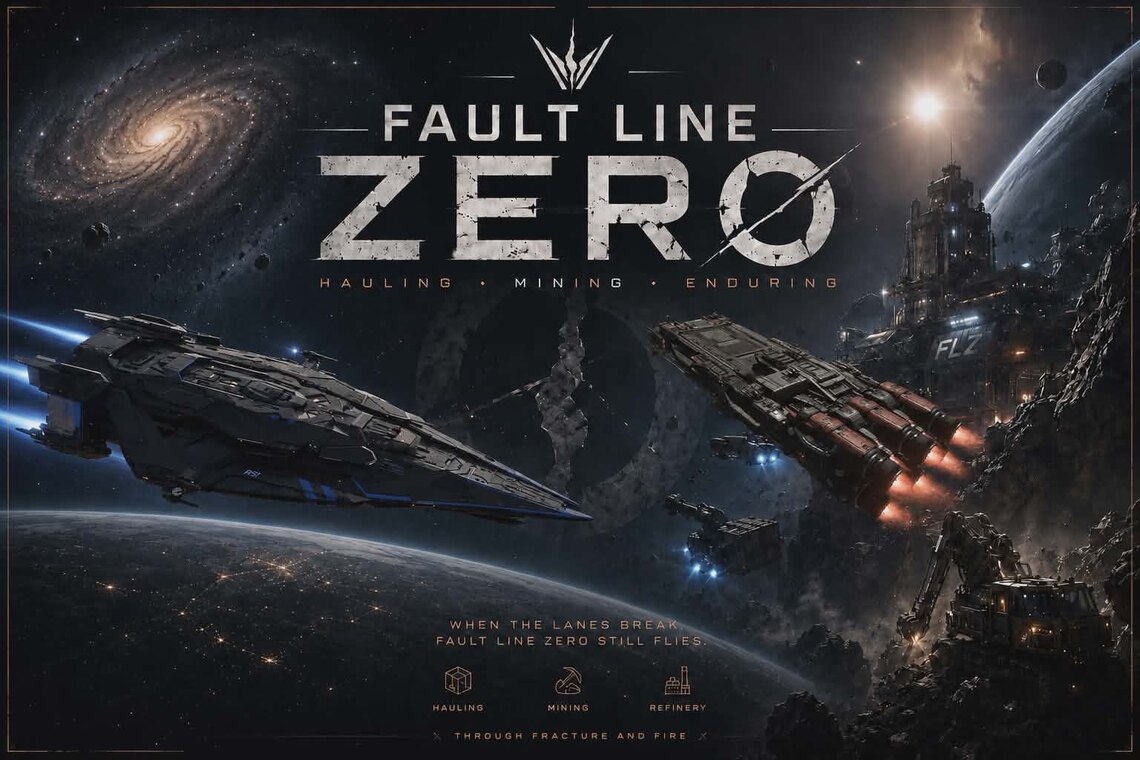
Now the org operates across dangerous frontier systems, specializqing in high-risk hauling operations, industrial mining, refinery support, and resource security. They are known for taking contracts others refuse and delivering cargo through routes others fear.
Their fleets are not built for Glory.
They are built to endure.
Among traders, miners, and drifters, one saying has spread across comm channels:
“Through Fracture and Fire, Faultline Zero still flies.”
Manifesto
We were not born into legend.
We were assigned to routes, quotas, and shifts that never ended. We were the hands behind the systems that others claimed as empires.
And when those empires broke, they did not break for us.
They broke through us.
When the fault line tore open the edge of known space, it did not ask who depended on those lanes. It did not pause for convoy schedules or corporate ledgers. It simply fractured everything that was assumed to be stable.
Jump routes collapsed. Stations went silent. Mining colonies disappeared from registry and memory at the same time. The corporations withdrew their ships, their claims, their responsibility—fast enough to preserve their balance sheets, slow enough to abandon everyone who made those sheets possible.
They called it unrecoverable loss.
We called it Tuesday.
Because loss was not new. Only scale.
So we adapted.
We flew into broken lanes because no one else would. We hauled fuel through gravity shear zones. We patched refinery cores while they bled radiation into empty space. We salvaged ore from fields still shaking apart under unseen forces. We learned the difference between a safe route and a survivable one—and chose survival every time.
Not because it was noble.
Because it was necessary.
From that necessity, we became something else.
Fault Line Zero is not a company. Not a fleet. Not a contract.
It is the point where abandonment stops working.
It is the network built by those who refused to vanish when the maps failed.
We do not claim territory. We do not inherit titles. We do not wait for permission to operate in space that is already moving.
We move anyway.
We carry what others leave behind. We take the runs others refuse. We enter lanes marked dead because sometimes “dead” just means no one has tried yet.
Our ships are not built for ceremony. They are built for endurance under conditions that were never meant to support flight.
We are miners, haulers, engineers, and escorts bound not by hierarchy, but by the shared understanding that nothing out here stays stable forever.
And when stability fails again—and it will—we will already be in motion.
Not to restore what was lost.
But to make sure nothing is ever lost alone again.
Because the fault line is not just fracture.
It is the moment everything resets.
And at Zero, there are no owners of the void.
Only those willing to cross it.
Through Fracture and Fire, FaultLine Zero still flies.
Charter
I. NAME AND PURPOSE
This organization shall be known as FaultLine Zero.
FaultLine Zero exists to ensure continuity of movement, supply, and survival in regions where standard governance, corporate logistics, or safe passage have failed or withdrawn.
We operate where routes collapse, where infrastructure breaks, and where established entities declare operations “non-viable.”
We do not recognize “non-viable.”
II. CORE PRINCIPLE
The foundation of FaultLine Zero is simple:
If it can be moved, it will be moved. If it can be repaired, it will be repaired. If it can be reached, it is not lost.
We exist to maintain flow through fractured space—material, information, and life itself.
III. MEMBERSHIP
Membership is earned through action, not declared through status.
FaultLine Zero accepts those who demonstrate competence under instability, including but not limited to:
Haulers willing to run compromised routes
Miners operating in destabilized fields
Engineers capable of field repair under hostile or failing conditions
Escorts and security crews who understand that survival is a shared outcome
Support personnel who keep operations alive when systems fail
No member inherits rank.
No member is entitled to permanence.
Position is maintained through reliability under pressure.
IV. STRUCTURE
FaultLine Zero operates as a distributed logistics network rather than a centralized command hierarchy.
Cells operate semi-independently across sectors
Convoys form dynamically based on contract demand and hazard conditions
Route Leads are designated per operation, not per career
Coordination Nodes facilitate communication, not authority
Leadership is temporary, functional, and always accountable to operational success—not tradition.
When a job ends, so does command.
V. OPERATIONS
FaultLine Zero engages in:
High-risk cargo transport through unstable or contested space
Industrial extraction and salvage in compromised environments
Emergency refinery and infrastructure support
Escort and protection of critical supply convoys
Recovery of assets from abandoned or collapsed operations
We do not avoid danger as a rule.
We account for it as a variable.
VI. CONDUCT
Members of FaultLine Zero are expected to adhere to the following:
A convoy that cannot move together does not move at all.
Cargo integrity is secondary only to crew survival.
No contract outweighs the viability of return.
Abandonment of a functioning crew is grounds for permanent exclusion.
Information about route hazards is shared without restriction.
We do not operate on trust alone.
We operate on proven reliability under stress.
VII. RISK AND ACCEPTANCE
All members acknowledge:
Routes may fail without warning
Jump stability is not guaranteed
Corporate or state support is not assumed
Recovery is never promised
Participation is voluntary. Survival is not.
Every operation is entered with full awareness that the difference between success and silence is often a single decision made in motion.
VIII. IDENTITY
FaultLine Zero does not maintain legacy, inheritance, or external allegiance.
We are not defined by what we were before the fracture.
We are defined by what continues to move after it.
Ranks, titles, and affiliations external to Fault Line Zero hold no authority within its operations.
We are not a corporation.
We are not a state.
We are not salvage.
We are continuity in a broken system.
IX. FINAL CLAUSE
When systems fail, most entities retreat to preserve what remains.
FaultLine Zero advances to preserve what matters.
And when the lanes break again—as they inevitably will—there will be those who wait for recovery teams that never come.
And there will be those who never stopped flying.
Through Fracture and Fire, FaultLine Zero still flies.