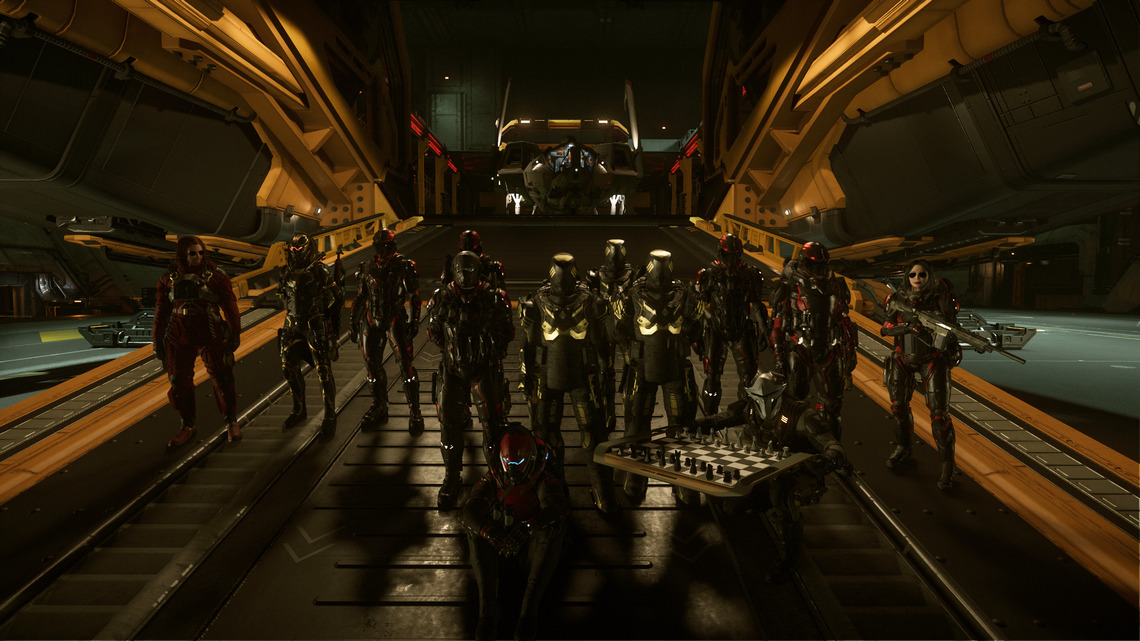
24 members
Obsidian Veil Tacticus / OVT1
-
 Security
 -
 Resources
Professionalism is the foundation.
Precision is how we fight.
Unity is our strength.
History
Obsidian Veil Tacticus was not created overnight.
Its history is built upon years of operations, friendships, failures, victories, reorganizations, and lessons carried forward by those who remained committed to building something better.
The organization known today as Obsidian Veil Tacticus — OVT represents the latest chapter of a lineage stretching back to 2952.
THE EARLY YEARS — 2952–2953
The roots of OVT can be traced to the communities and organizations where several of its future members first learned to operate together.
During this period, Cypher—then operating under the callsign Kasper—served alongside individuals who would influence the organizations that followed. Groups such as **Devil’s Brigade, Devil’s Navy, and United Earth Guard became part of that early history.
These years were far from perfect.
Mistakes were made. Trust was damaged. Leadership failed at times, including failures by individuals who would later help establish OVT.
Rather than erase that history, OVT recognizes it.
Those experiences became lessons about accountability, communication, leadership, and the consequences of placing ego above the people standing beside you.
The past cannot be rewritten.
It can, however, become the foundation for something better.
THE OLD GUARD
As the years continued, a core group of players repeatedly found themselves fighting alongside one another.
They became known simply as the Old Guard.
Among them were operators such as Hooman “JOKR,” Dylan “Funsize,” Sailor, Jeff, and others who served beside Cypher across multiple organizations and generations of the community.
Ships changed.
Organizations changed.
Callsigns changed.
The people beside you were what mattered.
Those relationships would eventually become one of the foundations upon which OVT was built.
START 2 CONQUER — 2955
By 2955, another chapter had begun.
Start 2 Conquer — S2C emerged as a more organized combat-focused group operating primarily throughout Stanton and Pyro.
Kasper had become Phantom Cypher, eventually assuming leadership responsibilities within the organization.
S2C participated in increasingly ambitious operations involving infantry assaults, bounty hunting, logistics, salvage, fleet combat, and combined-arms deployments.
Operations such as Veilbreaker, Ember Sky, Grave Tide, Shadow Freight, Phantom Veil, Black Sun, and Iron Tempest helped define this period.
The organization fielded vessels ranging from fighters and industrial craft to major combat assets such as the RSI Polaris Marked Blade and RSI Perseus Silent Bastion.
S2C became more than a collection of players.
It became a community.
But success did not make it immune to internal problems.
By late 2955, leadership disagreements, organizational instability, and breaches of trust exposed weaknesses that could no longer be ignored.
On November 5, 2955, Start 2 Conquer became **Start 2 Continue**—a name that reflected an organization attempting to evolve beyond what it had originally been.
Ultimately, however, another change was necessary.
THE VEIL RISES — 2956
From the remains of S2C came a new organization.
Obsidian Veil Tacticus.
OVT was not intended to simply rename what came before it.
It was intended to learn from it.
The organization adopted three principles:
Professionalism. Precision. Unity.
These words became more than a motto.
They became the standard.
Under the leadership of Cypher “Lingo,” Primarch of the Veil, OVT developed into a multi-role private military organization capable of supporting combat, logistics, medical operations, salvage, industry, reconnaissance, rescue, and fleet operations.
The organization was divided into specialized elements while maintaining the ability to operate together under a unified command structure.
At the center of its combat operations stood Blackline, OVT’s primary fighting force.
Around it grew the logistical, medical, industrial, reconnaissance, salvage, repair, and fleet capabilities required to sustain operations across the Verse.
OPERATIONS OF 2956
OVT quickly began establishing its own operational history.
Operation Storm Breaker brought OVT operators into the Farro Data Centers during a coordinated infantry operation supported by air and transport assets.
Operation Wormfall, conducted alongside allied forces, expanded the organization’s combined-arms capabilities through mechanized assaults, infantry operations, fleet coordination, and engagements surrounding Project Hyperion and Yormandi.
Operation Cutthroat demonstrated the effectiveness of small-team operations under extreme circumstances.
Operation Drake n’ Bake expanded OVT’s logistics capabilities.
Operation Phantom Veil emphasized smaller mercenary and bounty-hunting teams.
Operation Spear Resolve returned members to the Farro Data Centers while commemorating the history of the community that eventually became OVT.
These operations helped establish a doctrine that continues to define the organization:
Prepare seriously.
Execute professionally.
Enjoy the game.
ALLIANCES
OVT has never believed that strength requires isolation.
Throughout 2956, the organization worked alongside friends and allied organizations throughout the Verse.
Longstanding cooperation with members of Orbital Vanguard brought trusted operators such as Valoric “Judge,” DisasterZone “Killswitch,” SatisfiedComic “Vegas,” and TheToad “1984” into numerous OVT operations.
OVT later strengthened its relationship with Ad Astra, developing cooperation that expanded opportunities for larger joint operations and community events.
These partnerships represent an important part of OVT’s future.
We would rather build bridges than walls.
THE PEOPLE BEHIND THE VEIL
Ships can be replaced.
Equipment can be recovered.
Organizations can be rebuilt.
People cannot.
OVT’s history contains names of individuals who remain with us, those who moved on, and those whose paths may someday cross ours again.
Some departures were peaceful.
Others were difficult.
Some friendships survived organizational changes while others did not.
Every one of them contributed something to the history that brought OVT here.
We do not claim to have always made the correct decisions.
We do claim responsibility for learning from them.
A NEW DIRECTION
As 2956 continued, OVT began another evolution.
The organization moved away from unnecessarily rigid operations and toward a balance between structured tactical gameplay and an enjoyable community environment.
Military structure remains part of our identity.
It provides organization, responsibility, and clear leadership during operations.
But OVT exists first and foremost because people choose to spend their time here.
Our operations therefore range from organized deployments and combined-arms missions to casual game nights, industrial expeditions, bounty hunting, exploration, rescue operations, and whatever adventures the Verse provides next.
There will be serious missions.
There will be chaos.
There will probably be questionable decisions involving expensive spacecraft.
That is part of the experience.
THE VEIL TODAY
Today, Obsidian Veil Tacticus stands as the culmination of everything that came before it.
From the early days of 2952.
Through Devil’s Brigade and Devil’s Navy.
Through United Earth Guard.
Through the Old Guard.
Through Start 2 Conquer.
Through Start 2 Continue.
And finally—
Obsidian Veil Tacticus.
Different banners.
Different eras.
Many of the same people.
And countless stories still waiting to be written.
OVT welcomes combat pilots, infantry operators, medics, logisticians, miners, salvagers, engineers, explorers, bounty hunters, mercenaries, industrial players, and citizens simply looking for a community to call home.
Experience is welcome.
Character matters more.
You do not need to know everything.
You simply need to be willing to learn, contribute, and stand beside the people wearing the same crest.
## OUR STANDARD
Professionalism in how we represent ourselves.
Precision in how we approach the mission.
Unity in how we treat the people beside us.
We remember where we came from.
We accept the mistakes that brought us here.
We honor the people who helped build the road behind us.
And we continue forward.
The Veil is not simply an organization.
It is the next chapter of a story that began years ago—and there is still plenty of room for new names to be written into it.
Professionalism. Precision. Unity.
Obsidian Veil Tacticus
Manifesto
We are Obsidian Veil Tacticus.
We are not defined by a single ship, battlefield, leader, or moment in time.
We are defined by the people who stand beneath the same banner and by the standards we choose to uphold when no one is forcing us to uphold them.
We have existed under different names.
We have carried different callsigns.
We have fought beneath different banners.
We have succeeded together.
We have failed together.
And through every chapter, we have learned.
OVT exists because we believe a community can be organized without forgetting that this is a game. It can be disciplined without becoming oppressive. It can pursue victory without sacrificing friendship. It can respect leadership without silencing its members.
We take the mission seriously.
We do not take ourselves so seriously that we forget why we entered the Verse in the first place.
We are here to build something worth being part of.
—-
PROFESSIONALISM
Professionalism is not a rank.
It is not a uniform.
It is not a title displayed beside your name.
Professionalism is how you conduct yourself when representing the Veil.
We expect our members to treat one another, our allies, our opponents, and the wider Star Citizen community with respect.
Competition does not require toxicity.
Leadership does not grant superiority.
Experience does not give someone permission to belittle those still learning.
Every Prospect who enters OVT deserves the opportunity to become an operator.
Every operator deserves the opportunity to develop.
Every leader carries the responsibility to help make that possible.
Rank exists to create accountability and organization—not status.
A leader who forgets that has forgotten what leadership means.
—-
PRECISION
Precision does not mean perfection.
It means preparation.
When the Veil deploys, we strive to understand the objective, prepare the necessary equipment, coordinate our assets, and execute the mission effectively.
Sometimes the plan will work flawlessly.
Sometimes the first ship through the atmosphere will explode.
Sometimes someone will forget ammunition.
Sometimes a perfectly coordinated assault will be destroyed by a hangar door.
The Verse has its own sense of humor.
We adapt.
We regroup.
We continue.
Precision means learning from failure rather than being consumed by it.
The objective is always to become better than we were yesterday.
—-
UNITY
No individual stands above the Veil.
Not a Trooper.
Not a Captain.
Not a member of Veil Operations.
Not even the Primarch.
Leadership exists to serve the organization.
OVT succeeds when its members trust the people operating beside them.
The fighter pilot protecting a dropship matters.
The infantry operator inside that dropship matters.
The medic waiting to recover the wounded matters.
The logistician delivering equipment matters.
The salvager recovering what remains matters.
The engineer keeping the fleet operational matters.
The new Prospect experiencing their first deployment matters.
There are no insignificant roles when everyone contributes toward the same objective.
That is unity.
—-
WE REMEMBER WHERE WE CAME FROM
OVT was not born from perfection.
Our history stretches through organizations, communities, friendships, victories, disagreements, failures, and rebuilding.
Some of us remember Devil’s Brigade.
Some remember Devil’s Navy.
Some remember United Earth Guard.
Some remember the days of the Old Guard.
Others joined beneath the banner of Start 2 Conquer or Start 2 Continue.
Many joined only after the formation of Obsidian Veil Tacticus.
All of those chapters matter.
There were decisions in our past that we are proud of.
There were others we would never repeat.
We will not rewrite our history simply because parts of it are uncomfortable.
We will learn from it.
We will acknowledge our mistakes.
We will repair relationships where possible.
And when reconciliation is not possible, we will still carry the lesson forward.
The past explains who we were.
It does not dictate who we must become.
—-
THE VEIL IS EARNED
Membership in OVT is not measured by how many hours someone has played Star Citizen.
It is not measured by the size of their fleet.
It is not measured by their PvP record.
It is not measured by how loudly they speak in a command channel.
Skill can be taught.
Ships can be purchased.
Equipment can be replaced.
Character is harder to build.
We value the operator who admits a mistake.
We value the veteran who teaches the Prospect.
We value the pilot who turns around for the stranded member.
We value the medic who refuses to leave someone behind.
We value the person who shows up simply because their friends asked for help.
Those actions define the Veil.
—-
LEADERSHIP IS SERVICE
Leadership within OVT carries responsibility.
The higher you climb, the greater that responsibility becomes.
Leaders are expected to listen before speaking.
Teach before criticizing.
Correct without humiliating.
Take responsibility when plans fail.
Give credit when their people succeed.
No leader should demand loyalty while refusing accountability.
No rank makes someone immune from criticism.
No friendship places someone above organizational standards.
No title is permanent if the person carrying it stops serving the people beneath it.
OVT does not exist for its leadership.
Leadership exists for OVT.
—-
BROTHERHOOD BEYOND THE MISSION
Some nights we will deploy as a coordinated fighting force.
Other nights we will haul cargo.
Mine.
Salvage.
Explore.
Hunt contracts.
Run rescue missions.
Fight battles that have absolutely no strategic value.
Or spend three hours preparing for an operation only for Star Citizen to remind us that the greatest enemy in the Verse is sometimes the server.
All of it matters.
Because the objective of OVT is not simply victory.
It is creating stories worth remembering with people worth remembering them with.
The greatest measure of this organization will never be how many ships appear in a fleet photograph.
It will be whether the people in that photograph still want to fly together afterward.
—-
OUR ALLIES
The Veil does not need to stand alone.
We believe cooperation makes the Verse stronger.
Organizations willing to treat us with respect will receive respect in return.
Those willing to fight beside us will find the Veil beside them.
We will pursue partnerships built upon trust rather than convenience.
We will honor agreements.
We will support our allies.
And when disagreements occur, we will seek communication before conflict.
Our banner matters to us.
That does not mean another banner must matter less.
—-
NO ONE IS FORGOTTEN
Organizations change.
People leave.
Friends disappear from the Verse.
Some eventually return.
OVT will experience all of these things.
There are names throughout our history that no longer appear on our roster.
Some left as friends.
Some left through disagreement.
Some simply moved forward with their lives.
Their contributions remain part of our story.
The door does not have to remain permanently closed simply because someone once walked through it.
Where trust can be rebuilt, we are willing to rebuild it.
Where old friendships can be restored, we are willing to have the conversation.
The Veil remembers.
But remembering does not require hatred.
—-
OUR PROMISE
We will make mistakes.
We will lose battles.
We will lose ships.
We will make plans that survive exactly thirty seconds after first contact.
We will disagree.
We will change.
But there are principles we refuse to abandon.
We will respect the people beside us.
We will take responsibility for our actions.
We will teach those willing to learn.
We will protect the community we are building.
We will never allow rank to become more important than character.
We will never allow structure to destroy enjoyment.
We will never allow victory to become more important than the people who helped achieve it.
And above all:
We will continue.
—-
TO THOSE WHO WOULD JOIN US
You do not need to be the best pilot in the Verse.
You do not need years of combat experience.
You do not need a hangar filled with capital ships.
You do not need to know every mechanic.
Come willing to learn.
Come willing to contribute.
Come willing to teach what you know.
Come willing to stand beside people who will do the same for you.
Whether you are infantry, medical, logistics, salvage, mining, engineering, exploration, industry, bounty hunting, fleet operations, or simply someone searching for people to experience the Verse with—
There is a place behind the Veil for those willing to uphold its principles.
—-
WE ARE THE VEIL
We carry the lessons of those who came before us.
We build for those standing beside us.
And we leave something stronger for those who will come after us.
Different backgrounds.
Different specialties.
Different personalities.
One organization.
One standard.
One Veil.
Professionalism in our conduct.
Precision in our actions.
Unity in our purpose.
We are Obsidian Veil Tacticus.
We do not claim perfection.
We promise progress.
And wherever the Verse takes us next—
The Veil moves forward.
Charter
PREAMBLE
We, the members of Obsidian Veil Tacticus, establish this Charter to define the principles, responsibilities, authorities, and standards by which our organization shall operate.
OVT was forged from years of shared experience throughout the Verse. We carry forward the victories of our past, acknowledge its failures, and recognize the lessons learned from every organization and community that preceded us.
This Charter exists to ensure that no individual, regardless of rank or tenure, becomes greater than the organization they serve.
We believe structure should provide direction without destroying freedom.
We believe leadership should serve rather than dominate.
We believe discipline and enjoyment can coexist.
We believe every member deserves dignity, representation, and the opportunity to contribute.
Under the principles of:
Professionalism. Precision. Unity.
We establish this Charter as the governing foundation of Obsidian Veil Tacticus.
—-
ARTICLE I — PURPOSE OF THE VEIL
Section 1 — Mission
Obsidian Veil Tacticus exists to provide a structured, welcoming, and capable Star Citizen community supporting operations throughout the Verse.
OVT may conduct activities including, but not limited to:
- Infantry and combined-arms operations
- Fleet combat
- Fighter operations
- Bounty hunting
- Mercenary contracting
- Medical and rescue operations
- Logistics and cargo transportation
- Mining
- Salvage and recovery
- Repair and engineering
- Crafting and construction
- Exploration and reconnaissance
- Humanitarian operations
- Joint operations with allied organizations
- Casual and community events
No single gameplay profession shall define OVT.
The strength of the Veil comes from its ability to bring different specialties together toward a common objective.
Section 2 — Community
OVT is a community before it is a military structure.
Ranks, divisions, task forces, and command positions exist to facilitate organization and operations.
They shall never be used to determine the personal worth of a member.
—-
ARTICLE II — THE THREE PRINCIPLES
Every member of OVT shall operate according to three foundational principles.
Professionalism
Members shall represent OVT with maturity, accountability, and respect.
Professionalism does not require excessive formality. It requires knowing when seriousness is appropriate and treating others with dignity.
Precision
Members shall strive for preparation, competence, communication, and continuous improvement.
Precision does not require perfection.
Mistakes are expected.
Refusing to learn from them is not.
Unity
Members shall recognize that the strength of OVT comes from cooperation.
No division, task force, rank, specialty, or individual shall intentionally place personal prestige above the welfare of the organization.
Professionalism governs our conduct.
Precision governs our actions.
Unity governs our purpose.
—-
ARTICLE III — MEMBERSHIP
Membership within OVT is voluntary.
No member shall be required to treat OVT as employment or allow organizational responsibilities to supersede legitimate real-world obligations.
Real life comes first.
Section 1 — Prospects
New members can potentially enter OVT as Prospects.
The Prospect period exists to introduce new members to the organization, its culture, its members, and its operational practices.
Prospects are not lesser members of the community.
They are future operators learning how the Veil functions.
Section 2 — Full Membership
Prospects demonstrating appropriate conduct and compatibility with OVT may advance into full membership.
Advancement shall consider character, participation, willingness to learn, teamwork, and conduct.
Gameplay skill alone shall never determine whether someone belongs within OVT.
Section 3 — Equal Standing
Every member is entitled to basic respect regardless of:
Rank.
Experience.
Fleet size.
Gameplay specialization.
Combat ability.
Tenure.
Financial contribution.
No person purchases authority within OVT through ownership of ships, equipment, or other game assets.
—-
ARTICLE IV — RIGHTS OF MEMBERS
Every member of OVT shall possess the following organizational rights:
The Right to Respect — Members shall be treated with dignity by fellow members and leadership.
The Right to Speak — Members may respectfully voice concerns, disagreements, and recommendations.
The Right to Fair Treatment — Personal friendships, rank, or status shall not exempt individuals from organizational standards.
The Right to Learn — Members shall be allowed reasonable opportunities to develop within their chosen specialties.
The Right to Privacy — OVT shall respect reasonable personal boundaries and shall not demand unnecessary real-world information from its members.
The Right to Appeal — Members subject to significant disciplinary action may request review by higher organizational leadership.
The Right to Leave — Membership is voluntary. Any member may depart OVT without harassment or retaliation.
A former member shall not automatically be considered an enemy of the Veil.
—-
ARTICLE V — RESPONSIBILITIES OF MEMBERS
Membership carries responsibilities alongside rights.
Members are expected to:
- Represent OVT appropriately.
- Treat fellow members and allies with respect.
- Follow reasonable operational instructions during organized events.
- Communicate problems before they unnecessarily escalate.
- Protect sensitive organizational information when appropriate.
- Assist newer members when reasonably able.
- Accept constructive criticism.
- Take responsibility for mistakes.
- Avoid unnecessary drama, harassment, discrimination, or personal attacks.
- Remember that behind every character and callsign is another person.
OVT does not demand perfection.
It demands accountability.
—-
ARTICLE VI — COMMAND STRUCTURE
OVT shall maintain a command structure to provide accountability and operational organization.
The established rank structure is:
Grand Primarch / Primarch of the Veil
- Supreme organizational leadership.
Veil Operations
- Senior operational leadership.
Leadership
- Senior specialty command
Veil Trooper
- General/full members of the organization.
Prospect
- Candidate for full membership.
Ranks/positions may evolve as the organization grows.
Authority derives from responsibility—not personal importance.
—-
ARTICLE VII — THE GRAND PRIMARCH
The Grand Primarch of the Veil serves as the highest organizational authority within Obsidian Veil Tacticus.
The Grand Primarch is responsible for:
- Maintaining the organization’s long-term direction.
- Protecting the principles of this Charter.
- Appointing or removing senior leadership when necessary.
- Representing OVT during significant diplomatic matters.
- Resolving matters that cannot reasonably be settled through lower levels of leadership.
- Protecting the stability and continuity of the organization.
The position does not place the Grand Primarch above the principles of this Charter.
The Grand Primarch must remain accountable to the organization they lead.
The office exists to protect the Veil.
The Veil does not exist to protect the office.
—-
ARTICLE VIII — LEADERSHIP
Leadership within OVT is a responsibility rather than a reward.
Leaders shall be expected to:
- Lead by example.
- Maintain reasonable communication.
- Train and mentor members.
- Delegate responsibility.
- Recognize the achievements of their personnel.
- Accept responsibility for their decisions.
- Address disputes professionally.
- Avoid favoritism.
- Protect the interests of their members.
- Know when to lead and when to listen.
Rank shall never grant permission to humiliate, intimidate, or unnecessarily control another member.
Leaders who consistently violate these principles may be removed from command regardless of seniority.
—-
ARTICLE IX — DIVISIONS AND SPECIALTIES
OVT may establish divisions, departments, teams, and specialist positions as organizational requirements develop.
These may include:
- Blackline Division — Primary division for members of OVT.
- Orbital Vanguard — Secondary division for members of QRF (our partners).
- Ad Astra — Third Division for members of Ad Astra (our partners).
- Fleet Operations — Capital ships, combat fleets, escorts, and naval coordination.
- Medical — Battlefield medicine, rescue, casualty recovery, and support.
- Logistics — Cargo, transportation, supply, and operational sustainment.
- Salvage & Repair — Recovery, salvage, maintenance, and engineering support.
- Mining & Industry — Resource extraction and industrial activity.
- Crafting & Building — Manufacturing, construction, and infrastructure.
- Exploration & Reconnaissance — Scouting, intelligence gathering, navigation, and exploration.
Additional divisions and specialties may be established as Star Citizen and OVT continue to develop.
No division or specialty shall consider itself superior to another.
Each exists because the others cannot accomplish everything alone.
—-
ARTICLE X — TASK FORCES
OVT may establish specialized task forces for particular operational requirements.
Task forces may operate with greater autonomy than conventional divisions when their mission requires it.
Membership within a task force shall represent additional responsibility rather than elevated social status.
Selection may consider:
- Skill
- Reliability
- Teamwork
- Specialization
- Operational compatibility
- Experience
- Character
Task forces remain subordinate to the organizational command structure and this Charter.
—-
ARTICLE XI — OPERATIONS
OVT operations may range from highly coordinated deployments to casual community events.
Event leadership shall clearly communicate the expected level of organization before deployment whenever practical.
Members joining structured operations are expected to respect the established chain of command while the operation is active.
Operational authority begins with the mission.
It does not extend unnecessarily into a member’s personal time.
Members shall never be expected to address leadership by rank during normal social interaction unless they voluntarily choose to do so.
OVT is structured when structure is useful.
It is casual when structure is unnecessary.
—-
ARTICLE XII — DISCIPLINE AND ACCOUNTABILITY
Discipline within OVT exists to protect the community—not to create fear.
Whenever circumstances permit, leadership should seek correction before punishment.
Minor issues should generally be addressed through conversation, clarification, or counseling.
Repeated or serious violations may result in:
- Formal warnings.
- Temporary restriction from organizational activities.
- Removal from a leadership or specialist position.
- Reduction in position (if violator holds a position of power).
- Suspension (discord server timeout for a period of time).
- Removal from OVT.
Immediate removal may occur when behavior creates a serious threat to members, organizational security, or community safety.
Discipline shall not be used to silence legitimate criticism.
Personal disagreements shall not be disguised as disciplinary matters.
—-
ARTICLE XIII — CONFLICT RESOLUTION
Disagreements are inevitable.
Division is not.
Members are encouraged to resolve minor disputes directly and respectfully whenever appropriate.
When direct resolution is unsuccessful or inappropriate, leadership may mediate.
Members shall avoid intentionally escalating internal disputes through public arguments, rumor campaigns, harassment, or attempts to recruit others into personal conflicts.
Leadership shall attempt to understand all reasonable perspectives before making significant disciplinary decisions.
The objective of conflict resolution is not determining who can speak the loudest.
It is restoring trust where possible and protecting the community where it is not.
—-
ARTICLE XIV — ALLIES AND DIPLOMACY
OVT may establish partnerships, alliances, and cooperative agreements with other organizations.
Allies shall be treated with professionalism and respect.
Joint operations should respect the authority and organizational identity of all participating groups.
OVT shall not demand that allied organizations surrender their identity or internal autonomy as a condition of friendship.
Our allies stand beside us, not beneath us.
Likewise, OVT shall protect its own independence.
Diplomacy shall be preferred when diplomacy can reasonably resolve a dispute.
—-
ARTICLE XV — RETURNING MEMBERS
The Veil recognizes that people change.
Former members may request to return.
Departure from OVT shall not automatically prohibit future membership.
Returning members may be evaluated according to the circumstances of their departure, subsequent conduct, current relationships, and the interests of the organization.
Where reconciliation is possible, OVT should remain willing to pursue it.
Forgiveness does not require forgetting.
Accountability does not require permanent hostility.
—-
ARTICLE XVI — THE OLD GUARD
OVT recognizes the contributions of individuals and communities that existed before its founding.
The history of Devil’s Brigade, Devil’s Navy, United Earth Guard, the Old Guard, Start 2 Conquer, Start 2 Continue, and other predecessors forms part of the lineage that ultimately produced OVT.
This history shall be remembered honestly.
Past service may be honored.
Past mistakes may be acknowledged.
Neither shall grant permanent authority over the present organization.
OVT respects its history without becoming imprisoned by it.
—-
ARTICLE XVII — ORGANIZATIONAL CULTURE
OVT shall strive to maintain a culture where members can enjoy Star Citizen without unnecessary pressure.
We will take organized operations seriously.
We will train.
We will improve.
We will pursue difficult objectives.
We will build capable teams.
But we will also remember:
This is a game.
The purpose of organization is to improve the experience—not replace enjoyment with obligation.
A successful OVT operation is not measured exclusively by whether the objective was completed.
It is also measured by whether the people involved want to fly together again.
—-
ARTICLE XVIII — AMENDMENTS
This Charter is intended to evolve alongside OVT.
Changes in membership, leadership, organizational requirements, or Star Citizen itself may require amendments.
Amendments may be proposed by organizational leadership or through recommendations from members.
Major amendments affecting fundamental member rights, organizational principles, or command authority should receive consultation from senior leadership and the wider membership whenever practical.
No amendment shall casually discard the principles upon which OVT was established.
Professionalism. Precision. Unity.
—-
ARTICLE XIX — CONTINUITY OF THE VEIL
No single individual defines OVT.
Leadership will eventually change.
Members will come and go.
Divisions will evolve.
Ships will be destroyed.
Bases will move.
The Verse itself will change.
OVT must remain capable of surviving those changes.
The organization shall therefore prioritize sustainable leadership, mentorship, documentation, training, and succession.
The greatest accomplishment of any generation of OVT leadership will not be retaining authority.
It will be preparing the next generation to lead without them.
—-
ARTICLE XX — THE VEIL
To carry the crest of Obsidian Veil Tacticus is to represent more than yourself.
It represents those who built the organization.
Those currently standing beside you.
And those who have not yet joined us.
We therefore ask every member to remember:
Character before rank.
Team before ego.
Accountability before excuses.
Teaching before ridicule.
Communication before conflict.
People before pixels.
We will remember where we came from without allowing the past to control our future.
We will build friendships beyond divisions and organizations.
We will acknowledge our failures without allowing them to define us.
We will pursue excellence without demanding perfection.
And regardless of what waits beyond the next jump point—
We continue forward together.
PROFESSIONALISM.
PRECISION.
UNITY.
This is our standard.
This is our Charter.
We are Obsidian Veil Tacticus.