 9 members
THE COOP / SOGCOOP
-
 Infiltration
 -
 Freelancing
“Believe. Deploy. Obey.”
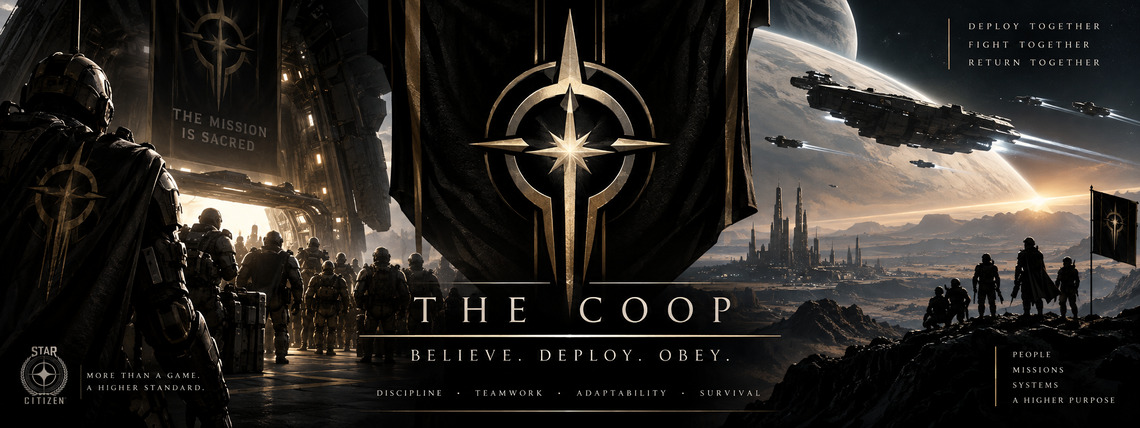
A faith-driven combat collective for hardcore tactical simulation players in Star Citizen. The Mission is sacred. Discipline, teamwork and adaptability sustain the flock. Doubt is weakness. Hesitation is failure. Deploy together. Fight together. Return together.
History
BELIEVE. DEPLOY. OBEY.
A faith-driven combat collective for hardcore tactical simulation players in Star Citizen.
The mission is sacred.
Discipline, teamwork and adaptability sustain the flock.
Doubt is weakness. Hesitation is failure.
Deploy together. Fight together. Return together.
THE BEGINNING
The Faith was not born in a temple.
It was born aboard ships.
It emerged in the silence before a boarding action, in the final equipment checks before deployment, in the voices of pilots confirming formation and in the discipline of soldiers who understood that survival in the ’verse depended upon something greater than individual skill.
Its earliest followers were not priests.
They were pilots, marines, medics, engineers, navigators and operators drawn together by a common frustration: too many organisations called themselves military while treating combat as little more than organised chaos.
Ships launched without escorts.
Ground teams advanced without reconnaissance.
Fireteams separated in pursuit of individual kills.
Orders became suggestions.
Communication collapsed under pressure.
And when the operation failed, everyone blamed everyone else.
Those who would form the Faith reached a different conclusion.
The individual was not the answer.
The unit was.
From that principle came the first doctrine:
Believe in the mission.
Deploy as one.
Obey the plan until circumstances demand adaptation.
Return with the flock.
What began as an operational philosophy gradually became something more.
It became belief.
THE FIRST CREED
The founders rejected the idea that faith required superstition.
Their faith was placed in preparation.
In the pilot holding formation.
In the gunner maintaining fire discipline.
In the marine covering the next doorway.
In the medic moving toward casualties while others moved away.
In the engineer keeping a damaged vessel alive long enough to bring its crew home.
In the commander accepting responsibility for every life placed under their authority.
This became known simply as the Creed.
The Creed taught that the mission was sacred because every deployment represented a commitment made between members of the organisation.
When one member deployed, none deployed alone.
When one vessel entered hostile space, the fleet entered with it.
When one operator was stranded, recovery became part of the mission.
Victory was measured not merely in enemies defeated or contracts completed, but in whether the organisation remained disciplined enough to extract its people and prepare for the next deployment.
From this principle came the words that would eventually define the Faith:
BELIEVE. DEPLOY. OBEY.
Believe in the mission, the preparation and those beside you.
Deploy with purpose, properly equipped and knowing your role.
Obey the command structure, tactical doctrine and responsibilities accepted when joining the operation.
Obedience was never intended to mean mindlessness.
A soldier who could only follow instructions was considered unfinished.
The Faith demanded something more difficult:
Disciplined adaptability.
Members were expected to understand the commander’s intent sufficiently well that when communications failed, plans collapsed or battlefield conditions changed, the mission could continue without the unit descending into disorder.
THE DOCTRINE OF THE FLOCK
As membership grew, individual crews became fireteams.
Fireteams became detachments.
Detachments became coordinated fleet elements.
With growth came doctrine.
The organisation abandoned casual deployment practices in favour of structured tactical simulation.
Every operation was treated as an exercise in combined capability.
Reconnaissance preceded commitment.
Intelligence shaped planning.
Pilots supported ground forces.
Ground forces protected landing zones.
Medical personnel planned casualty collection and extraction.
Engineers maintained operational continuity.
Logistics determined endurance.
Command maintained the larger picture.
No role existed in isolation.
This interdependence became known as the Flock.
The name was deliberately simple.
A flock survives not because every member performs the same function, but because individuals move with awareness of the whole.
Within the Faith, the strongest pilot is useless without fuel.
The strongest marine is useless without transport.
The strongest fleet is useless without intelligence.
The strongest commander is useless without disciplined people capable of executing intent.
Every member therefore carries two responsibilities:
Perform your function.
Protect the function of those around you.
THE YEARS OF FALSE VICTORIES
The organisation’s formative period was marked by what later doctrine would call the False Victories.
Operations were completed.
Targets were destroyed.
Contracts were fulfilled.
Yet the cost was repeatedly unacceptable.
Ships were unnecessarily lost.
Personnel became isolated.
Medical response was improvised.
A successful assault would be followed by a disorganised withdrawal.
The Faith came to recognise that tactical success and operational success were not the same thing.
Destroying the objective while losing half the deployment force was not victory.
Capturing ground while abandoning a disabled ship was not victory.
Winning the firefight while losing command cohesion was not victory.
This produced the principle that still governs Faith deployments:
RETURN TOGETHER.
Extraction became a planned phase of every mission rather than something considered after combat ended.
Recovery procedures were standardised.
Medical contingencies became mandatory.
Search-and-recovery responsibilities were assigned before deployment.
Commanders were expected to know not merely how they intended to enter an operation, but how every element would leave it.
The final objective of every deployment became simple:
Complete the mission. Preserve the force. Bring the flock home.
THE HARDENING
As the Faith matured, entry became more demanding.
Being able to fly did not make someone a pilot of the Faith.
Owning armour did not make someone infantry.
Possessing a large ship did not make someone a commander.
Capability had to be demonstrated.
Members began training in communications discipline, navigation, formations, boarding procedures, close-quarters battle, casualty evacuation, shipboard security, reconnaissance, logistics, recovery operations and coordinated aerospace-ground warfare.
Training deliberately introduced failure.
Communications disappeared.
Commanders became casualties.
Transport was destroyed.
Extraction points became compromised.
Medical resources were limited.
Objectives changed without warning.
Members learned that a plan surviving first contact unchanged was rare.
The objective was therefore never to memorise a sequence.
It was to understand intent.
That distinction became fundamental to the Faith’s philosophy:
Orders tell you what to do. Doctrine teaches you what to do when the orders are no longer enough.
The Faith became increasingly known not simply as a combat organisation, but as a home for players seeking hardcore tactical simulation within the Star Citizen universe.
Preparation mattered.
Equipment mattered.
Communications mattered.
Specialisation mattered.
Consequences mattered.
The organisation did not seek realism for its own sake.
It sought immersion created through discipline.
THE COMMANDMENT OF ADAPTATION
Eventually a fourth principle emerged alongside the original three.
Adapt.
The founders had learned that rigid obedience could become as dangerous as indiscipline.
An operator staring at an obsolete order while the battlefield changed around them was not displaying loyalty.
They were failing the mission.
The organisation therefore formalised Commander’s Intent.
Orders established the objective.
Doctrine established the boundaries.
Training established capability.
Within those boundaries, members were expected to think.
A fireteam leader could change an approach.
A pilot could abort a landing.
A medic could redirect an evacuation.
An engineer could prioritise survival systems.
A commander could abandon an objective when preservation of the force became strategically necessary.
Adaptability was not rebellion against command.
Adaptability was obedience to the mission at a higher level.
THE FAITH TODAY
Today the Faith exists as neither conventional religion nor ordinary military organisation.
It is a doctrine made communal.
A belief that disciplined players operating as a coordinated force can accomplish what isolated individuals cannot.
Its rituals are practical.
The briefing is congregation.
The armoury is preparation.
The hangar is the threshold.
The deployment is commitment.
The operation is trial.
The extraction is judgement.
And the return of the fleet is communion.
Members do not gather merely to possess ships.
They gather to crew them.
They do not collect weapons merely to carry them.
They train to employ them as part of a unit.
They do not pursue rank merely for status.
Rank represents responsibility.
Command is not privilege.
It is accountability for the mission and everyone entrusted to it.
The Faith welcomes those willing to learn.
It retains those willing to train.
It advances those willing to lead.
And it follows those who have demonstrated that they can bring others home.
OUR COVENANT
We believe preparation defeats panic.
We believe discipline defeats confusion.
We believe communication defeats isolation.
We believe adaptability defeats uncertainty.
We believe no ship, soldier, medic, pilot or commander succeeds alone.
We believe every deployment creates an obligation between those who undertake it.
And we believe the measure of an organisation is not how loudly it celebrates victory, but how reliably its people stand beside one another when the plan begins to fail.
There will be missions where the intelligence is wrong.
There will be landings where the zone is compromised.
There will be ships lost, systems failing, ammunition exhausted and communications severed.
There will be moments where hesitation is more dangerous than action.
Those moments are why the Faith exists.
Because when the plan fails, doctrine remains.
When command falls silent, training remains.
When certainty disappears, the flock remains.
BELIEVE.
Believe in those who trained beside you.
Believe that preparation has purpose.
Believe that your role matters.
Believe that the mission extends beyond yourself.
DEPLOY.
Deploy prepared.
Deploy equipped.
Deploy informed.
Deploy as part of something larger.
OBEY.
Obey the chain of command.
Obey tactical discipline.
Obey the responsibilities of your role.
Obey the covenant you accepted when others trusted you with their lives.
But when circumstances demand it—
Adapt.
Then finish the mission.
Recover the fallen.
Secure the wounded.
Retrieve the stranded.
Reform the formation.
Bring the ships home.
And count the flock.
THE MISSION IS SACRED.
Discipline, teamwork and adaptability sustain the flock.
Doubt is weakness.
Hesitation is failure.
DEPLOY TOGETHER.
FIGHT TOGETHER.
RETURN TOGETHER.
BELIEVE. DEPLOY. OBEY.
Manifesto
BELIEVE. DEPLOY. OBEY.
We are not a collection of individuals sharing the same server.
We are a combat collective bound by doctrine, discipline and mutual obligation.
We exist for players who want more from Star Citizen than isolated victories, casual formations and improvised combat.
We seek coordinated operations.
Structured command.
Defined roles.
Deliberate preparation.
Consequences.
Adaptation under pressure.
And the satisfaction of completing a mission because every member performed as part of a functioning whole.
OUR PURPOSE
The Faith exists to create a hardcore tactical simulation environment within Star Citizen built around coordinated aerospace, naval, ground and support operations.
Our objective is not to imitate military culture superficially.
Our objective is to create disciplined gameplay where planning, communication, logistics, intelligence, command and individual proficiency materially affect the outcome of every deployment.
Every member has a purpose.
Every role has consequence.
Every decision affects the unit.
The Faith therefore operates according to one central conviction:
The mission is sacred because the people committed to it have placed their trust in one another.
That trust will not be treated casually.
BELIEVE
Belief is not blind faith.
Belief is confidence earned through preparation.
Believe that the operator beside you has trained for their role.
Believe that the pilot assigned to extraction understands the plan.
Believe that the medic will move when casualties occur.
Believe that command has considered more than the immediate firefight.
Believe that when your own position becomes untenable, others are already working the problem.
Trust is not automatically granted because someone carries the Faith’s banner.
It is established through conduct.
Members earn trust by being reliable.
By attending training.
By learning procedures.
By acknowledging mistakes.
By communicating clearly.
By preparing properly.
By placing the success of the unit above personal recognition.
The Faith does not demand perfection.
It demands commitment.
DEPLOY
Deployment begins before weapons are drawn.
A mission starts with intelligence.
Then planning.
Then force selection.
Then equipment.
Then briefing.
Only then does the fleet move.
Members are expected to understand:
the mission objective;
the command structure;
their individual assignment;
their equipment requirements;
communications procedures;
primary and alternate routes;
medical procedures;
extraction plans;
contingency actions; and
the commander’s intent.
No operator should enter a mission without understanding why they are there.
No pilot should launch without knowing their role.
No ground element should move without considering extraction.
No commander should commit personnel without considering sustainment.
Preparation is not administrative overhead.
Preparation is combat power.
OBEY
The Faith maintains a defined chain of command because coordinated action requires authority.
During operations, orders are expected to be acknowledged and executed.
Arguments belong in planning.
Questions belong in briefing.
Lessons belong in debrief.
The battlefield is not the place for uncontrolled debate.
But obedience within the Faith is not stupidity.
A member is never expected to continue blindly when circumstances fundamentally change.
The highest obligation is to the mission and the preservation of the force.
Where direct orders become impossible to execute, members act according to doctrine and commander’s intent.
Where communications fail, leadership devolves.
Where leadership is lost, the next capable member assumes responsibility.
Where the plan fails, the Faith adapts.
Discipline provides structure.
Initiative provides survival.
Both are required.
THE FLOCK
No member of the Faith operates alone.
Even when physically separated, every operator remains part of a wider system.
A fighter pilot depends upon maintenance.
Infantry depends upon transport.
Transport depends upon security.
Security depends upon intelligence.
Intelligence depends upon reconnaissance.
Reconnaissance depends upon communications.
The wounded depend upon medical support.
The entire force depends upon logistics.
There are no insignificant roles.
The Faith rejects the culture in which every player attempts to become the hero of the operation.
Heroics may occasionally save a mission.
Dependable teamwork saves missions repeatedly.
The Faith therefore values the operator who holds position when ordered as much as the operator who makes the final assault.
It values the pilot who completes an uneventful transport run.
The engineer who keeps the ship operational.
The scout who identifies the threat before contact.
The medic who ensures casualties become survivors.
The logistics crew that makes the next deployment possible.
The mission belongs to all of them.
DISCIPLINE
Discipline is the foundation of the Faith.
It means maintaining communications when the situation becomes chaotic.
It means controlling fire rather than wasting ammunition.
It means remaining with the formation when personal opportunity appears elsewhere.
It means following assigned sectors.
It means confirming identification before engagement.
It means respecting operational security.
It means arriving prepared.
It means knowing when not to fire.
It means knowing when not to pursue.
It means accepting extraction when remaining behind would achieve nothing.
Discipline is not designed to remove enjoyment.
It creates the conditions in which coordinated gameplay becomes possible.
Without discipline there is noise.
With discipline there is intent.
ADAPTABILITY
No operation survives unchanged.
Vehicles are destroyed.
Ships are disabled.
Players become casualties.
Routes become blocked.
Targets relocate.
Intelligence proves incomplete.
Reinforcements arrive unexpectedly.
Servers themselves may become another operational hazard.
The Faith therefore trains for disruption.
Members must be capable of functioning when conditions become imperfect.
Commanders must be capable of abandoning assumptions.
Fireteam leaders must be capable of acting without constant supervision.
Pilots must be capable of selecting alternate landing zones.
Medics must prioritise casualties.
Engineers must triage systems.
Every member must understand enough of the wider mission to continue contributing when the original plan becomes impossible.
Adaptability is not disorder.
It is disciplined improvisation.
COMMUNICATION
Communication must be clear, brief and useful.
During tactical operations, unnecessary radio traffic weakens situational awareness.
Members are expected to communicate information that changes decisions.
Contact.
Position.
Direction.
Strength.
Status.
Casualties.
Ammunition.
Movement.
Threat.
Requirement.
The Faith does not reward the loudest voice.
It values the clearest information.
When combat begins, communications become another weapon system.
Use them accordingly.
LEADERSHIP
Rank within the Faith is not decoration.
It represents responsibility.
Leaders are expected to know more, prepare more and accept greater accountability than those they command.
Authority is not a reward for longevity.
It is entrusted to those capable of exercising it.
A leader must be able to:
understand the mission;
communicate intent;
allocate resources;
recognise changing conditions;
make decisions under pressure;
protect the cohesion of the unit;
accept responsibility for failure; and
develop those who will eventually replace them.
The Faith does not require leaders who are always correct.
It requires leaders capable of deciding when certainty is unavailable.
Once a decision is made, the unit acts.
After the mission, the decision may be examined without ego.
That process makes the organisation stronger.
TRAINING
Training is part of membership.
The Faith does not expect every recruit to arrive experienced.
It does expect every recruit to improve.
Training may include:
small-unit tactics;
shipboard operations;
close-quarters battle;
boarding and counter-boarding;
convoy operations;
fighter escort;
aerospace coordination;
reconnaissance;
navigation;
communications;
casualty evacuation;
combat medicine;
engineering response;
logistics;
search and rescue;
extraction under pressure;
command exercises; and
combined-arms operations.
Training is not punishment.
It is where mistakes are supposed to occur.
The battlefield is where those lessons are tested.
FAILURE
The Faith does not pretend failure can be eliminated.
Ships will be lost.
Objectives will be missed.
Poor decisions will be made.
Operations will collapse.
The organisation is judged by what follows.
Failure must be examined.
Not concealed.
Not blamed away.
Not converted into personal conflict.
Every significant deployment should answer:
What happened?
Why did it happen?
What worked?
What failed?
What changes before the next deployment?
A failure that produces improvement has value.
A failure that teaches nothing will eventually repeat itself.
VICTORY
Victory is not simply the destruction of an enemy.
A mission may be tactically successful and operationally disastrous.
The Faith measures success against the objective.
Was the mission completed?
Was the force preserved?
Were casualties recovered?
Was unnecessary loss avoided?
Was command maintained?
Did members fulfil their responsibilities?
Did the operation strengthen the organisation for the next deployment?
Sometimes victory means holding ground.
Sometimes it means taking it.
Sometimes it means rescuing one person.
Sometimes it means refusing battle.
Sometimes it means withdrawing before the enemy realises the Faith has already achieved its objective.
We do not fight simply because combat is available.
We fight because the mission requires it.
NO ONE IS EXPENDABLE
The Faith understands that losses are sometimes unavoidable.
It does not accept unnecessary sacrifice.
Members are resources only in the coldest tactical sense.
They are also the organisation itself.
Extraction is therefore part of planning.
Medical support is part of planning.
Recovery is part of planning.
Search and rescue are part of planning.
A stranded member represents an unresolved mission variable.
A wounded member represents a responsibility.
A disabled vessel represents a decision to be made deliberately rather than abandoned automatically.
The Faith will not destroy itself chasing impossible recoveries.
But neither will it abandon its people because recovery is inconvenient.
The principle remains:
DEPLOY TOGETHER.
FIGHT TOGETHER.
RETURN TOGETHER.
CONDUCT
Those carrying the Faith’s banner represent the organisation.
Skill does not excuse poor conduct.
Rank does not excuse arrogance.
Experience does not excuse contempt.
Members are expected to treat each other with the same discipline demanded during operations.
Disagreement is permitted.
Disruption is not.
Criticism is permitted.
Humiliation is not.
Competition is permitted.
Sabotage of the unit is not.
The Faith can be demanding without becoming toxic.
Standards exist to improve the collective.
They are not tools for personal superiority.
OUR MEMBERS
The Faith seeks players who value:
teamwork over ego;
discipline over chaos;
competence over appearance;
adaptability over rigidity;
preparation over improvisation;
mission success over individual statistics;
and collective survival over personal glory.
You do not need to know everything before joining.
You must be prepared to learn.
You do not need the largest ship.
You need to perform your role.
You do not need military experience.
You need discipline.
You do not need to speak constantly.
You need to communicate when it matters.
You do not need to be fearless.
You need to act despite uncertainty.
THE COVENANT
When we deploy, we accept responsibility for more than ourselves.
We protect the mission.
We protect the formation.
We protect the person beside us.
We maintain discipline when confusion begins.
We communicate when others need information.
We adapt when the plan becomes obsolete.
We lead when leadership is required.
We follow when another has been entrusted to lead.
We recover those we can.
We learn from those we cannot.
We do not waste lives for pride.
We do not abandon objectives through fear.
We do not confuse hesitation with caution.
We do not confuse recklessness with courage.
We act deliberately.
We act together.
THE CREED
Believe in the mission.
Believe in your training.
Believe in those beside you.
Deploy prepared.
Deploy with purpose.
Deploy as one.
Obey the command structure.
Obey tactical discipline.
Obey the responsibility you accepted when the mission began.
And when the situation changes—
Adapt.
When the formation breaks—
Reform.
When one falls—
Recover them.
When the mission is complete—
Return together.
BELIEVE. DEPLOY. OBEY.
The mission is sacred.
Discipline, teamwork and adaptability sustain the flock.
Doubt is weakness.
Hesitation is failure.
Deploy together.
Fight together.
Return together.
Charter
BELIEVE. DEPLOY. OBEY.
This Charter establishes the standards, responsibilities, command principles and operating rules of the Faith.
Membership signifies acceptance of this Charter.
Participation in an operation signifies acceptance of the appointed command structure for that operation.
The Faith exists as a hardcore tactical simulation organisation within Star Citizen, built around coordinated gameplay, disciplined communication, defined roles, operational planning and collective responsibility.
The purpose of this Charter is simple:
Preserve cohesion.
Protect the mission.
Protect the flock.
I. THE CREED
All members are expected to understand and uphold the core doctrine:
Believe. Deploy. Obey.
Believe in the mission.
Believe in preparation.
Believe in the people beside you.
Deploy prepared.
Deploy informed.
Deploy with purpose.
Obey the operational chain of command.
Obey established doctrine.
Obey the responsibilities attached to your assigned role.
When circumstances invalidate the original plan:
Adapt according to commander’s intent.
II. THE MISSION IS SACRED
The mission takes precedence over individual recognition.
Members will not deliberately compromise an operation for personal kills, loot, statistics, spectacle or unnecessary risk.
Personal initiative is encouraged only where it supports the mission.
Every deployment must be understood in terms of:
objective;
command structure;
force composition;
rules of engagement;
logistics;
casualty response;
extraction;
contingencies; and
commander’s intent.
A member who does not understand their task is expected to clarify it before deployment.
III. THE FLOCK
The Faith operates collectively.
No member is above the organisation.
No operational role is inherently superior to another.
Pilots, infantry, engineers, medics, reconnaissance personnel, logistics crews, command personnel and support elements are all part of the same operational system.
Members will support the assigned function of others.
Members will not deliberately abandon another member where recovery remains tactically reasonable.
Members will not compromise the wider force through reckless rescue attempts.
The balance is deliberate:
Recover where possible.
Preserve the force where necessary.
IV. CHAIN OF COMMAND
Every formal operation will have an identified commander.
Subordinate leadership positions may include:
fleet commander;
ship captain;
flight leader;
ground commander;
platoon or section leader;
fireteam leader;
medical lead;
engineering lead;
reconnaissance lead;
logistics lead; and
extraction lead.
Operational authority exists for the duration and scope of the assigned mission.
Orders from an appointed commander are expected to be acknowledged and executed unless:
the order is impossible;
the operational situation has materially changed;
the member lacks the capability to execute it;
execution would directly contradict a higher operational directive; or
immediate adaptation is necessary to preserve the mission or force.
Where deviation is required, the member should communicate the deviation as soon as practical.
V. COMMANDER’S INTENT
Orders cannot anticipate every circumstance.
Commanders must therefore communicate intent, not merely instructions.
Members are expected to understand:
What must be achieved.
Why it must be achieved.
What conditions constitute success.
When communications fail or leadership is lost, members will act according to that intent.
Where a leader becomes unavailable, command passes to the next designated or appropriately qualified member.
Operational paralysis is unacceptable.
VI. DISCIPLINE
Discipline is mandatory during formal operations.
Members must:
remain with assigned formations unless directed otherwise;
maintain assigned sectors and responsibilities;
control weapons fire;
avoid unnecessary radio traffic;
acknowledge critical orders;
report significant contacts and casualties;
maintain operational security;
follow movement and extraction instructions;
avoid unnecessary pursuit;
preserve mission-critical equipment; and
maintain professional conduct.
Repeated indiscipline may result in removal from the operation and organisational review.
VII. COMMUNICATIONS
Operational communications will be concise, relevant and structured.
Priority information includes:
contact;
location;
direction;
number or strength;
movement;
casualties;
ammunition state;
vehicle or ship status;
immediate threat;
support requirement; and
extraction requirement.
Members will avoid unnecessary conversation on tactical channels during active operations.
Command channels are for command traffic.
Fireteam channels are for local coordination.
Emergency traffic takes precedence over routine traffic.
When communications fail, members revert to established doctrine and mission intent.
VIII. RULES OF ENGAGEMENT
Rules of engagement may vary by mission.
The designated commander will define mission-specific ROE before deployment where necessary.
Unless otherwise ordered, members will:
positively identify targets where practical;
avoid deliberate friendly fire;
avoid firing through friendly positions without coordination;
minimise unnecessary collateral damage;
avoid uncontrolled fire;
avoid engagement that unnecessarily compromises the mission;
report unexpected contacts;
respect surrender or disengagement where operationally appropriate;
protect non-hostile personnel where practical; and
preserve intelligence, equipment or personnel designated for capture.
Fire discipline is a command responsibility and an individual responsibility.
IX. FRIENDLY FIRE
Negligent friendly fire is unacceptable.
Accidental friendly fire will be reviewed in context.
Members are expected to:
identify sectors;
maintain positional awareness;
communicate movement;
confirm targets;
avoid crossing active firing lanes without coordination; and
immediately report accidental friendly fire.
Deliberate friendly fire against members of the Faith without authorised training purpose will be treated as a serious breach.
X. FORCE PREPARATION
Members are responsible for arriving prepared for assigned operations.
Preparation may include:
appropriate armour;
weapons;
ammunition;
medical supplies;
environmental equipment;
food and hydration where relevant;
mission-specific tools;
vehicles;
ship equipment;
fuel;
repair capability; and
communications configuration.
The Faith does not require every member to own specialised equipment.
It does require members to communicate capability limitations before deployment.
A mission should not discover after contact that a critical role cannot perform its function.
XI. TRAINING
Training is an organisational obligation.
Members may be required to complete training relevant to operational roles.
Training may cover:
communications;
formations;
weapons handling;
close-quarters combat;
shipboard combat;
boarding;
vehicle operations;
navigation;
aerospace operations;
reconnaissance;
casualty care;
extraction;
search and rescue;
logistics;
engineering;
convoy procedures;
leadership; and
combined-arms operations.
Training is intended to build interoperability.
Individual skill without team integration is insufficient.
XII. ROLE QUALIFICATION
Members may express interest in any operational discipline.
Assignment to specialist or command roles may require demonstrated capability.
Roles involving substantial responsibility may require:
training completion;
supervised deployment;
practical assessment;
operational experience;
familiarity with doctrine; and
demonstrated reliability.
Ownership of a ship, vehicle or item does not automatically grant command authority over an operation.
Capability takes precedence over possession.
XIII. LEADERSHIP
Leadership within the Faith is responsibility, not status.
Leaders must:
prepare before deployment;
understand the objective;
communicate clearly;
assign achievable tasks;
maintain situational awareness;
protect force cohesion;
make decisions under pressure;
adapt when conditions change;
accept accountability; and
conduct or contribute to debriefing.
Leaders are expected to correct mistakes without humiliation.
Authority must not be used for personal disputes or ego.
XIV. OPERATIONAL READINESS
Formal operations may specify readiness requirements.
Members who commit to an operation are expected to attend where reasonably possible or provide notice where circumstances change.
The Faith recognises that Star Citizen is a game and real-world obligations take precedence.
However, repeated commitment followed by unexplained absence may affect assignment to critical roles.
Reliability matters because other members may structure the mission around an individual’s role.
XV. EXTRACTION
Extraction is part of the mission.
It is not an afterthought.
Where applicable, planning must include:
primary extraction point;
alternate extraction point;
casualty extraction;
disabled vehicle or ship contingencies;
lost member procedures;
regroup locations;
emergency withdrawal procedures; and
recovery priorities.
Members must not unnecessarily delay extraction for personal objectives.
When withdrawal is ordered, the force withdraws.
XVI. CASUALTIES
A casualty changes the mission.
It does not automatically end it.
Medical personnel will determine treatment priorities where assigned.
Members will:
report casualties;
secure the casualty where possible;
provide immediate aid within their capability;
protect medical personnel;
facilitate evacuation; and
avoid creating additional casualties through reckless response.
The organisation values recovery.
It does not endorse suicidal recovery attempts without operational justification.
XVII. VEHICLE AND SHIP COMMAND
A vessel or vehicle may have an assigned captain or commander.
The assigned captain maintains authority over the safe operation of that platform.
During larger operations, platform commanders remain subordinate to the designated operational commander.
Crew members will respect assigned stations and responsibilities.
Unauthorised movement, launch, weapon discharge or abandonment of mission-critical platforms may constitute a breach of operational discipline.
XVIII. LOGISTICS
Logistics is a combat function.
Fuel, ammunition, medical supplies, repair materials, replacement equipment and transport determine operational endurance.
Members assigned logistics responsibilities are part of the combat system, not peripheral support.
Operational plans should account for sustainment before extended deployment.
An operation that cannot sustain itself is already approaching failure.
XIX. INTELLIGENCE AND RECONNAISSANCE
Information must be collected before unnecessary commitment.
Reconnaissance personnel should avoid compromising themselves unless authorised.
Intelligence may include:
enemy location;
force strength;
ship types;
movement;
environmental hazards;
approach routes;
landing zones;
defensive positions;
extraction routes; and
mission-critical infrastructure.
Information is only useful if communicated.
Members will report significant intelligence through appropriate channels.
XX. OPERATIONAL SECURITY
Sensitive organisational information must be protected.
Members will not knowingly disclose:
operation times;
force composition;
staging locations;
internal communications;
tactical procedures;
command information;
planned targets;
reconnaissance findings; or
confidential organisational matters
where such disclosure could compromise an operation or the organisation.
Operational security applies before, during and after deployment.
XXI. MULTI-ORGANISATION MEMBERSHIP
Membership in other Star Citizen organisations is not automatically prohibited.
However, external affiliations must not compromise:
Faith operations;
internal information;
command integrity;
operational security;
member safety; or
organisational interests.
Members participating in another organisation remain responsible for protecting Faith information.
Where conflicts of interest exist, they should be disclosed to leadership.
XXII. INTERNAL CONDUCT
The Faith is intentionally demanding in gameplay standards.
It is not an excuse for abusive behaviour.
Members will not engage in:
targeted harassment;
malicious humiliation;
discrimination;
deliberate disruption;
griefing of fellow members;
sabotage of organised operations;
repeated abuse of authority; or
deliberate attempts to fracture the organisation.
Tactical criticism is acceptable.
Personal degradation is not.
The Faith values professionalism because cohesion is operationally useful.
XXIII. DISAGREEMENT
Members may disagree with decisions.
During planning, reasoned challenge is encouraged.
During combat, the appointed commander makes the decision.
Where immediate safety or mission survival requires action, members may adapt.
Where disagreement does not require immediate action, the matter is addressed during debrief.
Debrief exists for learning, not revenge.
XXIV. DEBRIEF
Significant operations should conclude with a debrief where practical.
Debrief may examine:
objective achievement;
command decisions;
communications;
casualties;
equipment losses;
tactical performance;
intelligence accuracy;
logistics;
extraction;
unexpected events;
errors;
successful procedures; and
required changes.
Rank does not exempt a member from review.
Leaders are expected to accept criticism where supported by operational facts.
XXV. FAILURE
Failure is not automatically misconduct.
Poor judgement, insufficient information, game instability and enemy action can all contribute to failure.
The organisation distinguishes between:
failure despite reasonable action
and
failure caused by repeated negligence or indiscipline.
The former is analysed.
The latter may require corrective action.
XXVI. CORRECTIVE ACTION
Minor breaches should generally be corrected at the lowest appropriate level.
Corrective action may include:
verbal instruction;
retraining;
temporary removal from specialist duties;
reassignment;
formal warning;
removal from leadership;
suspension from organised operations; or
removal from the organisation.
Response should reflect severity, context, intent and repetition.
The purpose of discipline is to protect the organisation, not create spectacle.
XXVII. SERIOUS BREACHES
Serious breaches may include:
deliberate sabotage;
intentional friendly fire;
disclosure of sensitive operational information;
targeted harassment;
malicious impersonation of command;
repeated refusal to follow lawful operational direction;
exploitation of organisational access for hostile purposes;
deliberate theft from members or organisational resources where applicable; or
conduct seriously damaging to the Faith.
Serious matters may result in immediate restriction or removal.
XXVIII. RANK
Rank represents responsibility and demonstrated trust.
It does not create personal superiority.
Members of higher rank are expected to:
demonstrate doctrine;
support training;
maintain standards;
develop junior members;
act with restraint;
avoid favouritism; and
accept increased accountability.
A rank that exists only as decoration has no value.
XXIX. PROMOTION
Promotion may consider:
reliability;
tactical competence;
communication;
teamwork;
training participation;
leadership potential;
judgement;
understanding of doctrine;
willingness to support others; and
operational conduct.
Length of membership alone does not guarantee promotion.
Neither does combat performance alone.
The Faith advances people it can trust with greater responsibility.
XXX. RECRUITMENT
The Faith recruits for attitude before equipment.
Applicants should demonstrate:
willingness to learn;
capacity to operate within a team;
respect for command structure;
ability to communicate;
maturity under pressure;
interest in tactical simulation; and
acceptance of organisational standards.
Prior military, simulation or tactical gaming experience may be useful.
It is not mandatory.
Doctrine can be taught.
Character is harder to manufacture.
XXXI. PROBATION
New members may enter a probationary period.
Probation exists to determine whether the organisation and recruit are compatible.
Probationary members may train, deploy and participate while demonstrating:
reliability;
communication;
discipline;
teamwork; and
willingness to improve.
Probation is assessment, not punishment.
XXXII. REAL LIFE TAKES PRECEDENCE
The Faith may operate with hardcore simulation standards.
It remains a gaming organisation.
Real-world employment, family, health and personal responsibilities take precedence over gameplay.
Members are not expected to compromise real-life obligations for the organisation.
The standard expected is communication, not sacrifice.
If you cannot attend:
Say so.
If you must leave:
Say so.
If circumstances change:
Say so.
The mission can adapt when command has information.
XXXIII. THE STANDARD
Every member should be able to answer four questions before deployment:
What is the mission?
What is my role?
Who is commanding me?
What do I do if the plan fails?
If those answers are unclear, preparation is incomplete.
XXXIV. FINAL COVENANT
By serving under the Faith’s banner, we accept that our actions affect others.
We will prepare.
We will communicate.
We will maintain discipline.
We will follow command.
We will question intelligently during planning.
We will adapt intelligently during failure.
We will not pursue personal glory at the expense of the mission.
We will not abandon the flock without necessity.
We will not confuse recklessness with courage.
We will not confuse obedience with thoughtlessness.
We will learn from failure.
We will respect the responsibility carried by every member.
And when the order is given—
We deploy together.
When contact begins—
We fight together.
When the mission ends—
We return together.
BELIEVE. DEPLOY. OBEY.
The mission is sacred.
Discipline, teamwork and adaptability sustain the flock.
Doubt is weakness.
Hesitation is failure.
DEPLOY TOGETHER.
FIGHT TOGETHER.
RETURN TOGETHER.